

Embedded Insurance Market Research Highlights 27.5% CAGR Growth Trajectory
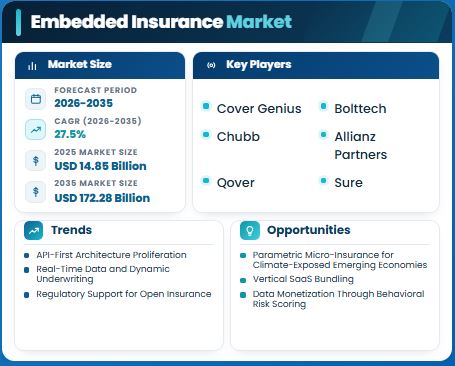
embedded insurance market
Embedded Insurance Market Size, Share and Research Report By Policy Type (Homeowners, Renters, Auto, Travel, Life), By Distribution Channel (Insurance agents)
The Embedded Insurance Market is transforming customer experiences by seamlessly integrating insurance products into digital purchase journeys across multiple industries.”
SEOUL, SEOUL, SOUTH KOREA, July 6, 2026 /EINPresswire.com/ -- The Global embedded insurance market reached USD 14.85 billion in 2025 and is projected to grow from USD 19.35 billion in 2026 to USD 172.28 billion by 2035, registering a CAGR of 27.5% during the forecast period. — Market Research Future (MRFR)
Two major catalysts are accelerating this extraordinary trajectory the European Union’s Insurance Distribution Directive revisions that explicitly recognize non-insurance platform distribution dismantling the regulatory ambiguity that had historically inhibited carriers from pursuing platform-embedded distribution at scale and a wave of venture capital exceeding USD 4.2 billion deployed into insurtech infrastructure between 2023 and 2025, which has built the API rails connecting carriers to digital checkout flows at global e-commerce platforms, fintech super-apps, mobility services, and vertical SaaS ecosystems.
The embedded insurance market is no longer a niche concept; it is becoming the default distribution paradigm for personal-lines coverage worldwide, with online and API-first placements capturing approximately 71.0% of total market revenue in 2025 as legacy broker-intermediated placement progressively cedes ground to real-time policy issuance woven directly into consumer purchase journeys.
What makes this shift structural rather than cyclical is the scale and irreversibility of the digital commerce infrastructure now embedding insurance. Global e-commerce platforms processed more than USD 6.3 trillion in gross merchandise value in 2024, and every one of those transactions represents a latent insurance touchpoint from shipping protection and extended warranties at electronics checkout, to travel disruption coverage at airline booking, to pay-per-mile auto policies activated through connected-car infotainment systems.
Carriers integrating IoT telemetry, purchase-history signals, and behavioral analytics into real-time pricing engines have reduced loss ratios by 8–12 percentage points on embedded electronics lines compared with traditionally rated products, while parametric triggers powered by real-time weather and flight-status data have cut claims-processing costs by 40% on embedded travel policies.
Chubb’s November 2025 launch of its AI-Powered Optimization Engine for the Chubb Studio platform delivering real-time, personalized embedded insurance offers through proprietary data-driven insights and bolttech’s June 2025 closure of a USD 147 million Series C funding round at a USD 2.1 billion valuation illustrate the speed of enterprise-scale investment and innovation defining this market.
Get Full PDF Sample Copy of Report: (Including Full TOC, List of Tables & Figures, Chart) @
https://www.marketresearchfuture.com/sample_request/24048
➤ How Significant Is the Embedded Insurance Market’s Growth?
The embedded insurance market has demonstrated extraordinary expansion, nearly doubling year-over-year in monetized platform premium volumes and projected to achieve a nearly 12-fold increase over the 2025–2035 decade. This growth trajectory reflects the compounding effect of three simultaneous forces: the dramatic expansion of digital commerce and fintech ecosystems creating new insurance distribution touchpoints at unprecedented scale; the API infrastructure buildout enabling insurance product launch timelines to compress from 12–18 months to under 90 days; and regulatory green lights in major markets reducing compliance friction that had historically discouraged non-insurance platforms from distributing coverage.
Electronics protection accounted for approximately 47.9% of the embedded insurance market in 2025, driven by smartphone and laptop attachment rates on global e-commerce sites, while micro auto insurance is projected to grow at a 36.2% CAGR through 2035, fueled by connected-car telematics and pay-per-mile policy structures.
The automotive segment generated the largest application share of approximately 30% in 2025, as OEM-embedded usage-based insurance programs through Tesla, Hyundai, and Stellantis demonstrated that at-purchase policy binding during vehicle transactions can lift dealer finance and insurance gross profit by 20–31% per deal. Travel and ticketing coverage maintained the second-largest revenue base, reflecting post-pandemic recovery in cross-border bookings where parametric flight-delay and trip-cancellation triggers are enabling near-instant claims settlement that traditional indemnity policies cannot match.
Vertical SaaS platforms are the fastest-growing partner channel type at a 31.3% CAGR, as property-management, fleet-software, and healthcare workflow vendors bundle coverage natively into subscription products turning insurance from a standalone purchase decision into an invisible background service that activates automatically on workflow events.
➤ What Does the Future Hold for the Embedded Insurance Market?
Generative AI and real-time dynamic underwriting stand at the forefront of the embedded insurance market’s next growth phase. Generative AI is transforming embedded insurance by automating policy generation, personalizing product recommendations based on real-time behavioral and transactional data, and enhancing customer support through AI-driven conversational interfaces that can quote, bind, and explain coverage without human agent involvement.
Chubb’s AI-Powered Optimization Engine within Chubb Studio exemplifies how incumbent carriers are embedding intelligence into their platform partnership infrastructure enabling digital distribution partners to improve engagement and conversion through dynamically personalized insurance offers that adapt to individual user context at the moment of purchase rather than relying on static rate tables.
Parametric micro-insurance for climate-exposed emerging economies represents the single most transformative growth opportunity shaping the embedded insurance market’s future. By replacing indemnity-based loss assessment with index triggers automatically paying policyholders when a weather station records rainfall below a defined threshold or a flood sensor exceeds a defined water level parametric embedded policies can serve agricultural smallholders, coastal property owners, and urban micro-businesses in markets where traditional claims adjustment infrastructure is absent or prohibitively expensive.
The EIOPA open-insurance framework expected to be finalized by mid-2026 will mandate standardized data-sharing protocols between carriers and distribution platforms across the EU a regulatory catalyst that will simultaneously unlock new embedded distribution opportunities and raise compliance requirements for cross-border platform operators. Singapore’s MAS and India’s IRDAI have each launched sandbox programs specifically for embedded distribution models, with over 45 pilot programs approved across the two jurisdictions between 2023 and 2025, providing the regulatory clarity that accelerates institutional carrier investment in embedded product development and platform partnership infrastructure.
➤ Who Are the Key Players in the Embedded Insurance Market?
The embedded insurance landscape is characterized by a mix of global incumbent carriers competing for integration slots, API-native insurtech infrastructure providers enabling platform distribution at scale, and specialist MGA and program business operators targeting specific vertical integration opportunities. Key participants shaping the competitive dynamics include:
Cover Genius - the global embedded insurance platform leader, whose proprietary XCover infrastructure enables real-time, localized protection products across e-commerce, travel, and fintech verticals; partners include eBay for shipping protection and rental car insurance, with April 2025 expansion into ticket protection via a SECUTIX partnership automating refund processes for venue and event businesses.
Bolttech - a USD 2.1 billion-valued global insurtech platform that closed a USD 147 million Series C in June 2025 with Sumitomo Corporation and Iberis Capital as strategic investors; expanded into East Africa through its December 2025 acquisition of mTek, a Nairobi-based digital insurance platform, and partnered with Sumitomo in May 2025 to deliver technology-driven embedded solutions across Asian markets.
Chubb - a global multi-line incumbent carrier whose Chubb Studio platform has become one of the market’s premier embedded distribution infrastructure layers; the November 2025 launch of its AI-Powered Optimization Engine enables digital distribution partners to receive real-time, personalized insurance offers powered by proprietary data analytics, combining Chubb’s product breadth with dynamic contextual targeting.
Allianz Partners - the embedded distribution arm of Allianz Group, delivering travel, mobility, health, and assistance insurance through API integrations with airlines, OTA platforms, automotive OEMs, and financial services partners, leveraging the global reinsurance capacity and carrier licensing of the Allianz group to underwrite embedded programs at institutional scale across more than 75 countries.
Qover - a Belgium-based API-first embedded insurance orchestration platform partnering with fintechs, neobanks, and mobility platforms across Europe to deliver white-label coverage products including cycling insurance, gig-worker protection, and consumer electronics cover through fully automated API-driven policy issuance workflows.
Sure - a U.S.-based embedded insurance technology platform enabling carriers and distributors to design, launch, and manage digital insurance programs; January 2025 new product suite launch expanded its embedded solutions into health, cyber, and gig economy coverage lines targeting vertical SaaS platform partners.
Zego - a specialist commercial embedded insurance provider using API technology to offer flexible, pay-as-you-go coverage for gig-economy platforms including Uber and Deliveroo, enabling real-time coverage activation and deactivation that matches driver operational status without annual policy commitments.
Lemonade - an AI-native insurance carrier whose cloud-native underwriting architecture and behavioral data models position it as both a direct carrier and an embedded infrastructure partner, with its modular insurance APIs enabling fintech platforms to offer renters, pet, and life insurance as subscription-tier benefits within digital financial service bundles.
Competition in the market is intensifying as API-centric insurtechs race to deepen vertical integrations while incumbent carriers leverage licensing, reinsurance capacity, and brand credibility to secure marquee partnership slots on global e-commerce and fintech platforms. Regulatory know-how and integration agility are emerging as the two defining competitive differentiators, as cross-border embedded programs require both technical API excellence and the ability to navigate distinct consent, licensing, and product disclosure requirements across dozens of jurisdictions simultaneously.
➤ What Are the Emerging Trends in the Embedded Insurance Market?
Several transformational trends are redefining how the embedded insurance market evolves through 2035:
API-First Architecture & Sub-90-Day Product Launch Cycles: The shift from file-and-quote legacy systems to RESTful API stacks has compressed insurance product launch timelines from 12–18 months to under 90 days, enabling platforms like Shopify which processed over USD 235 billion in GMV during 2024 to offer one-click insurance integration modules that attach coverage at checkout without any carrier-side custom development. This infrastructure acceleration is the single most important near-term growth driver for the embedded insurance market.
Real-Time Dynamic Underwriting & Parametric Triggers: Carriers integrating IoT telemetry, satellite weather data, flight-status feeds, and purchase-history behavioral signals into real-time pricing engines are achieving 8–12 percentage point loss ratio improvements on embedded electronics lines, while parametric flight-delay triggers powered by live aviation data are cutting travel claims processing costs by 40% compared to indemnity-based adjustment workflows making embedded distribution economically viable at micro-premium price points that traditional channels cannot serve profitably.
Generative AI-Powered Personalization at Point-of-Sale: Generative AI models analyzing transaction context, browsing behavior, and user profile signals are enabling carriers to dynamically surface the most relevant insurance offer at the exact moment of purchase decision moving embedded insurance from static checkout add-on prompts to intelligent, contextually personalized coverage recommendations that adapt in real time to individual risk profile and purchase intent signals.
Open Insurance Frameworks & Regulatory Sandbox Expansion: EIOPA’s open-insurance data-sharing mandate expected by mid-2026, Singapore MAS sandbox approvals, India IRDAI open framework initiatives, and U.S. state-level program business facilitation are collectively building the regulatory infrastructure for embedded insurance to operate as a licensed, compliant, cross-border distribution channel rather than navigating jurisdiction-by-jurisdiction licensing complexity that has historically constrained platform partner ambitions.
Connected-Car & Mobility-Embedded Policy Activation: With the global connected-car fleet surpassing 500 million vehicles in 2024 and each generating approximately 25 gigabytes of driving data per hour, OEM partnerships with carriers including Tesla, Hyundai, and Stellantis enabling usage-based policy activation directly through infotainment systems are transforming automotive insurance distribution from dealership F&I desks into seamless in-vehicle digital experiences. Micro auto insurance is the fastest-growing insurance line at a 36.2% CAGR through 2035.
Vertical SaaS Bundling & Behavioral Risk Monetization: Property-management platforms, fleet-management SaaS, healthcare workflow tools, and gig-economy operator platforms are becoming the fastest-growing embedded insurance distribution channel at a 31.3% CAGR, bundling coverage as a native subscription tier benefit that improves platform retention and unlocks behavioral risk data monetization through embedded underwriting partnerships with carriers seeking real-time exposure intelligence.
Get access to the full description of the report @
https://www.marketresearchfuture.com/reports/embedded-insurance-market-24048
➤ How Is the Embedded Insurance Market Segmented?
The embedded insurance market report provides a comprehensive segmentation framework:
By Policy Type: Homeowners, Renters, Auto (Pay-Per-Mile & Usage-Based), Travel, Life, Electronics Protection, Cyber, Gig-Worker Protection
By Distribution Channel: Online & API-First Platforms, E-Commerce & Marketplace Checkouts, Financial Institutions & Bancassurance, Insurance Agents & Brokers, Vertical SaaS Partner Platforms
By Product Offering: Single-Product Embedded Policies, Bundled Insurance Packages, Parametric Index-Based Policies, Micro-Insurance & On-Demand Coverage
By Application: Automotive & Mobility, Consumer Electronics & Warranties, Healthcare & Wellness, Travel & Hospitality, Fintech & Digital Banking, Property & Real Estate, Gig Economy & Freelance Platforms
By End-User Industry: E-Commerce & Retail, Financial Services & Neobanks, Insurance Carriers & MGAs, Automotive OEMs & Dealerships, Healthcare Providers, Travel & Airlines, Property Management
➤ What Are the Regional Insights from the Embedded Insurance Market?
North America commands approximately 34.2–36.7% of the global embedded insurance market share in 2025, anchored by the world’s most mature digital retail ecosystem, a permissive state-level regulatory framework for program business that has historically welcomed non-insurance platform distribution, and the highest concentration of global insurtech infrastructure companies whose API platforms power embedded programs worldwide.
The United States market is particularly advanced in automotive embedded insurance where Polly’s Q2 2025 Quarterly Embedded Auto Insurance Report documented that dealers introducing insurance quotes into the sales process achieved a 20% lift in F&I gross profit, or an extra USD 313 per deal, rising to a 31% lift when customers purchased a policy illustrating the cross-selling economics driving OEM and dealership embedded insurance adoption.
Asia-Pacific is the fastest-growing region at a 20.7% CAGR through 2035, driven by the world’s largest greenfield digital insurance opportunity across India, China, Indonesia, Vietnam, and the Philippines, where hundreds of millions of mobile-first consumers are reaching insurance-buying age and digital-wallet penetration is creating frictionless embedded policy distribution infrastructure that bank branch-based distribution never could. China’s Japan market is projected to reach USD 13.57 billion by 2026, China USD 37.68 billion, and India USD 13.78 billion.
Europe holds the second-largest market share at approximately 24.5%, led by open-insurance sandbox programs in Germany and the United Kingdom, the EIOPA open-insurance framework anticipated by mid-2026, and advanced fintech ecosystems in the Netherlands, France, Sweden, and Poland that are integrating travel, renters, and micro-mobility coverage into super-app and neobank subscription tiers.
South America and the Middle East and Africa represent the highest-potential emerging market regions for embedded insurance, driven by mobile-money ecosystem expansion, rapidly growing e-commerce adoption, and large underinsured populations whose first insurance experience will be embedded at the point of digital transaction rather than through a traditional agent.
➤➤➤ Industry Analysis Reports by Market Research Future:
Business Analytics In Fintech Market
https://www.marketresearchfuture.com/reports/business-analytics-in-fintech-market-29077
Cash Advance Service Market
https://www.marketresearchfuture.com/reports/cash-advance-service-market-29143
Banking Encryption Software Market
https://www.marketresearchfuture.com/reports/banking-encryption-software-market-29232
Optical Time Domain Reflectometer Market
https://www.marketresearchfuture.com/reports/optical-time-domain-reflectometer-market-29250
Digital Transformation In Bfsi Market
https://www.marketresearchfuture.com/reports/digital-transformation-in-bfsi-market-29558
Digital Tv Soc Market
https://www.marketresearchfuture.com/reports/digital-tv-soc-market-29584
Asset Management It Solution Market
https://www.marketresearchfuture.com/reports/asset-management-it-solution-market-29809
Cfd Trading Affiliate Programs Market
https://www.marketresearchfuture.com/reports/cfd-trading-affiliate-programs-market-29947
Barrier Films Flexible Electronic Market
https://www.marketresearchfuture.com/reports/barrier-films-flexible-electronic-market-29987
Bit Error Rate Tester Market
https://www.marketresearchfuture.com/reports/bit-error-rate-tester-market-30054
Sagar Kadam
Market Research Future
+ +1 628-258-0071
email us here
Legal Disclaimer:
EIN Presswire provides this news content "as is" without warranty of any kind. We do not accept any responsibility or liability for the accuracy, content, images, videos, licenses, completeness, legality, or reliability of the information contained in this article. If you have any complaints or copyright issues related to this article, kindly contact the author above.
